
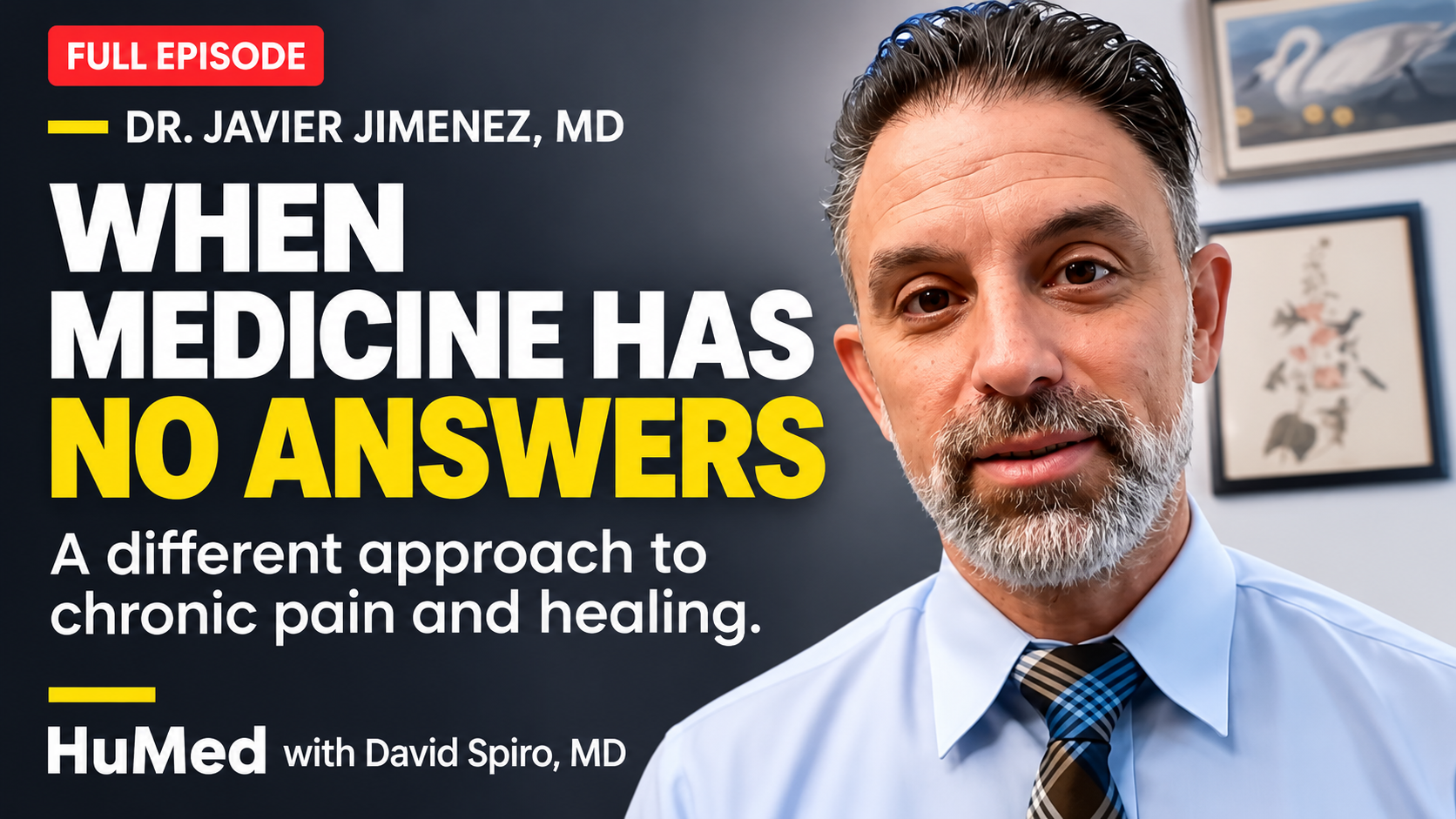
Xavier Jimenez is a psychiatrist, a pain physician and an addiction specialist, board certified in all three. He works as a consultation-liaison psychiatrist at Northwell Health, New York’s largest health system, where he also teaches and trains residents. He has practiced in Boston, Cleveland and New York, and he came to medicine with a background in philosophy. This conversation is about what happens when medicine has no answers, and why “we just don’t know” may be the most honest thing a doctor can say.
A few moments from behind the scenes:
I got through three questions.
I came in with a list of ten or fifteen questions and managed to ask three of them. That is usually a sign of a good conversation. It also means Xavier has to come back.
He doesn’t fully know either.
Xavier describes physicians as humans with an “inner universe.” When I asked him what that means, he smiled: “I’m not so sure I know what it is, and that’s intentional.”
He modeled it live.
When he walked me through how to tell a family “I don’t know,” he paused to point out that he was doing it right then, with his body language and eye contact. It was a small teaching moment I did not expect.
The poet who runs.
Xavier writes poetry, runs marathons, plays a lot of baseball with his two boys, and cooks dinner with his wife every night.
The story at the heart of the episode
About 20 years ago, as a psychiatry resident on the medical floors, Xavier was consulted on a young man in his twenties with end-stage kidney disease who had stopped going to dialysis. He was homeless, had an intellectual disability and likely schizophrenia, and he was agitated and refusing care.
What stayed with Xavier wasn’t only the medicine. It was how the team reacted. Medicine wanted the patient on inpatient psychiatry. Inpatient psychiatry wanted him medically stable first. Consult psychiatry, in his words, “was being asked to perform magic.” The patient was stuck in a turf war. Xavier didn’t judge anyone. He got curious about why each doctor felt the way they did.
In the end, the chief medical officer brought everyone to the same table, and the team got back to the original mission. The young man was dialyzed and went on to psychiatric care. Xavier wrote the case up, and it started a lifelong interest in how clinicians react to hard situations.
Why this is the human side of medicine
I asked Xavier the question that frustrates so many of us in the pediatric ER: what do you do for a child with chronic pain when the family wants answers and you don’t have one? His answer was simple and hard. Validate how real it is. Be honest, even when that means saying, “We just don’t know.” And build places where these patients can actually go, so they aren’t bounced between specialties.
We also talked about moral injury, the post-COVID surge in children coming to the ER with behavioral health emergencies, and a young colleague of mine who led a 3 a.m. debrief after one of those nights went badly. That debrief is now leading to our first in-situ simulation for a behavioral health emergency, something I have never done in 30 years.
Near the end, I asked how Xavier takes care of himself. He thinks in week-long chunks and keeps checking in on what each part of his life needs. “It’s not just work-life balance,” he said. My takeaway: keep checking in with ourselves, because we bring all of it to the bedside.
Watch the full conversation on YouTube, or listen on Apple Podcasts.