
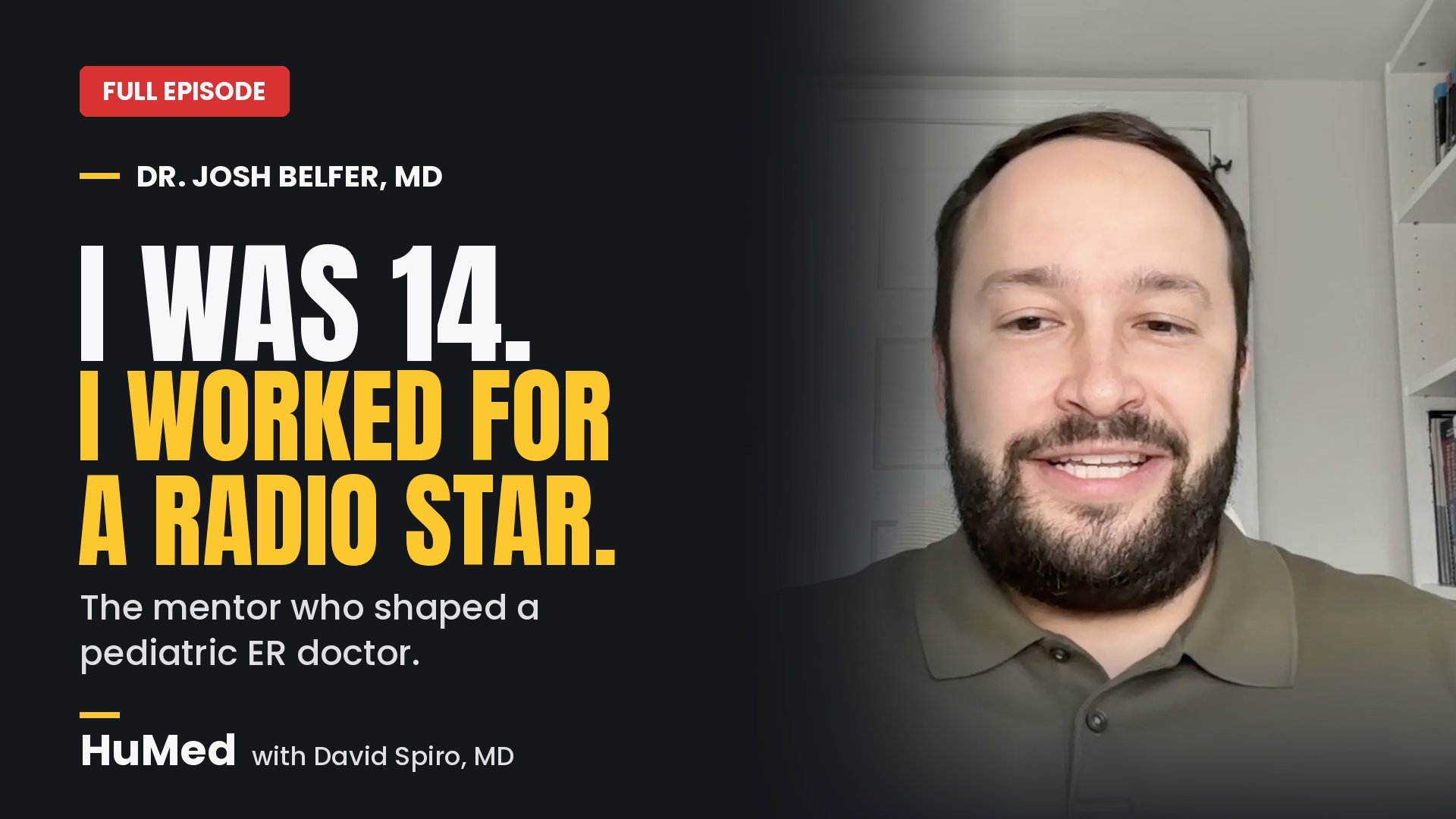
Josh Belfer is a pediatric emergency medicine attending at Children’s Hospital of Philadelphia, affectionately known as CHOP or “the mothership,” and an assistant professor of clinical pediatrics at Penn. He studied Health and Societies at Penn, earned his MD at Rutgers, did his pediatric residency and a chief resident year at Cohen Children’s, and completed his pediatric emergency medicine fellowship at Columbia. He is also interested in resident burnout and free open access medical education. This conversation is about the radio host who took a 14-year-old seriously, and the short email that turned into six years at his side.
A few moments from behind the scenes:
He did his homework. Josh had seen a number of episodes and went back to watch a few more before we recorded. He found exactly one thing in common with a recent guest who had served in the Navy: “I did meet my wife on Hinge though.”
Making it look official. Sent out to cover a public meeting as a teenager, Josh printed the 1210 The Big Talker logo from Google Images and taped it to the side of his “huge recording device” so he would “look official.” One of the people who gave him an interview that night later became mayor of Philadelphia.
The statute of limitations. At a Franklin Institute panel on steroids in baseball, the organizers announced that no recording was allowed. Josh hit record anyway. His verdict today: “I think we’re probably hopefully out of the statute of limitations for that one.”
“You can wait in line.” Josh followed José Canseco into an elevator for a quick interview, asked a hard-hitting question that got him “shut down on that real quickly,” and then, being a teenage baseball fan, asked for an autograph. Canseco’s answer: “You can wait in line.”
Rapid fire. As a former New Yorker, I closed with three rapid-fire questions. Sixers or Knicks? Sixers. (“Did I fail already?”) Phillies or Mets? Phillies. Flyers or Rangers? Flyers, “although I’m not much of a hockey fan, to be honest.”
The story at the heart of the episode
Josh titled his story “How a Discman and a Baseball Card Led Me to Where I Am Today.” The Discman part starts in 2004. He was a high school freshman in southern New Jersey, riding a 45-minute bus to school in Philadelphia every morning. His friends slept. He couldn’t. What he did have was a Discman.
His dad was an avid talk radio listener and a big fan of Michael Smerconish, who was doing morning drive on 1210 AM, the Big Talker. His suggestion: push the little button on the Discman over to AM and see what you think. Josh liked what he heard, especially a host who approached the issues his own way, regardless “of what the political party says I should say.”
That November, his dad went to the station’s election night special. The station was right up the street from Josh’s high school, so his dad asked whether his son could come in one morning. They said yes, probably expecting a high schooler to watch for an hour or two. “Suffice it to say, that was not that.”
Josh stopped at Dunkin’ Donuts for coffee and donuts to “make a good impression,” walked through hallway after hallway of what was then the NBC10 studios, and ended up in “this little kind of shoebox studio,” sitting across from Michael. During commercial breaks, Michael would turn to him and ask about high school and what he was interested in, then “flip the switch right back onto the radio mode.”
They left it simple: if Josh saw a story Michael might use on air, send it in. Josh knew how that sounded. “I was 14 years old.” Michael was waking up at 3 a.m. for a 6 a.m. show and going through every newspaper in the country. “What am I gonna contribute to him?” He sent stories in anyway, every couple of days.
A few months later, Michael reached out with an assignment. He was working on a book about a Philadelphia police officer who was shot in the line of duty, and he asked Josh to research one of the chapters and write up three to four pages. Josh put his head down at the desktop computer in his room and made the deadline. Then the reply came. Michael’s emails were never long, “maybe one or two sentences.” This one said: “This is fantastic. Great work. Very impressed by your work, I’m going to send you more stuff to do.”
Josh calls that “the turning point.” Over the next six years, through high school and into college at Penn, he worked with Michael as an intern who was “really a researcher”: research for the show, that book and three or four more after it, interviews, and field reporting he would bring back to the studio and sometimes talk about on air. One morning at 6:45, news of a foiled terrorist attack broke. Josh watched Michael rebuild the show on the fly, then found himself standing in Michael’s office next to a well-known TV political talk show host, watching the Today show cover the story. “This is like pretty cool,” he remembers thinking.
Why this is the human side of medicine
Josh says those mornings taught him what the pediatric ER asks for every shift: “being able to turn on a dime and being able to direct your focus to the most pressing thing.” As he put it, he “probably could have figured I was set out to be an ER doctor.” Being the 14-year-old among college-age interns taught him something else he still carries at CHOP: learn from everyone, and “be confident, but be modest.”
Becoming a dad changed things too. His daughter is about to turn one, and his wife is a pediatric hospitalist. “I feel what my patients feel more now that I’m a father.” He knows that with a child who has stridor, “90 plus percent of the time I’m gonna throw on the racemic epinephrine nebulizer and within five minutes the kid’s gonna look much better. But the parents are hearing that noise thinking that their child’s not going to be able to breathe in the next few minutes.” What we sometimes call bread-and-butter pediatrics, he reminded me, is “not routine for our patients.”
And there is a thread that runs through the whole conversation. When a resident goes through a hard case with him, Josh makes sure they know they can step away, and a few days later he checks in, often with a short email. The kid who got two sentences back from a radio host at 14 is now the attending sending a couple of sentences to a resident. As I said to Josh, the act of asking “Are you okay?” is “an incredibly empowering act because it lets the resident know that you care.”
One line to take with you
Josh said it about checking in on residents after a hard case, but it is exactly what Michael Smerconish did for him at 14, and it’s the line I’m carrying from this conversation: “It could be a one sentence email, two sentence email, but it really means a lot.”
Josh works behind the scenes on The PEM Podcast (formerly the CHOP PEM Podcast), which his father, Dr. Robert Belfer, hosts: clinically applicable, evidence-based conversations with experts in pediatric emergency medicine.
Watch the full conversation on YouTube, or listen on Apple Podcasts.