
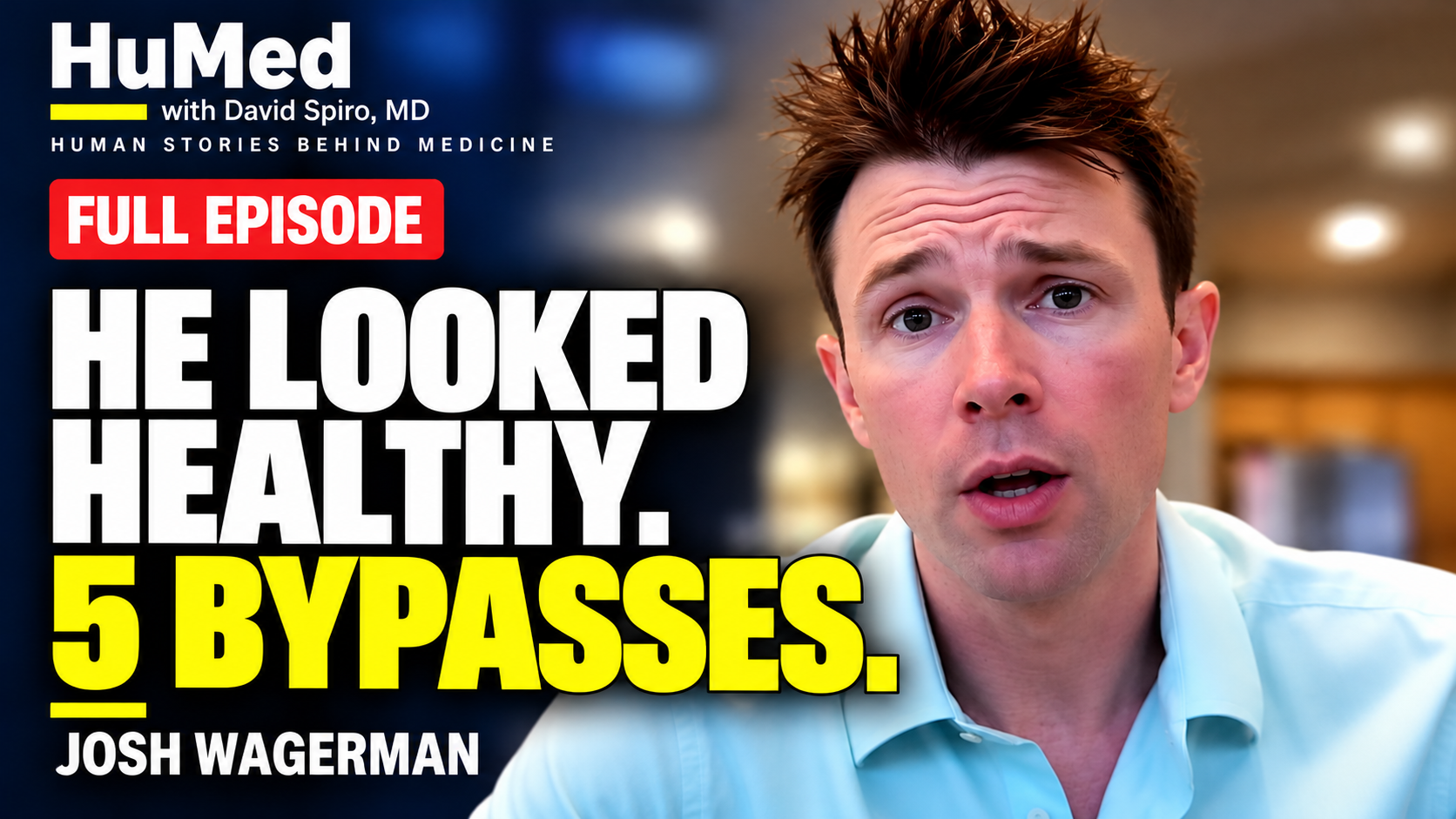
Josh Wageman is a clinical lipid specialist who practiced in endocrinology, with a PhD focused on cholesterol disturbances and Alzheimer’s disease, a doctorate in physical therapy, and PA training at Yale. He teaches as an adjunct professor at several medical programs and wrote The Home Security System and the Lipid Neighborhood, a book that aims to bring “clarity and hilarity” to a famously confusing topic. This conversation is about a fit, healthy-looking friend whose routine numbers said he was fine, and the two extra tests that showed he was “a ticking time bomb.”
A few moments from behind the scenes:
He’s got a lot of school. Reading Josh’s introduction, I worked through the PhD, the doctorate in physical therapy and the lipid work, then had to stop and say it out loud: “He’s got a lot of school.” A moment later I realized I had skipped PA school entirely and had to circle back.
Stories over textbooks. Josh told me why he was excited to come on a show built around stories: “Some people like reading textbooks. I’m one of them, but that’s rare. Most people really resonate with stories.” He tells stories about real people because that’s how listeners “come away really deeply affected and hopefully a better clinician, a better person, a better friend.”
The shirt. One of Josh’s catchphrases is “Got plaque? Get a CAC.” He had shirts made, including a muscle shirt he wears to the gym. When someone asks what it means, his answer is “I’m glad you asked,” and it usually turns into a pro bono workup on the spot.
Growing up fat free. I told Josh I’m 60 and grew up in the ’70s, when everything had to be fat free. His take on diet was refreshingly undogmatic: several approaches can work, but “the standard American diet is just not one of them.” His baseline: “prioritize protein and eat real food.”
The story at the heart of the episode
Josh calls this story “Beyond the 10-Year Risk Calculator.” The friend at the center of it is a physician assistant in dermatology, “a real wizard” with sutures who showed Josh different ways to tie. Josh ran cross country and track at Idaho State, and the two became running partners. As Josh put it, “When you run with people, you can really talk about a lot of things. And I’m notoriously wordy anyway.”
On a run at about 5:30 one morning, his friend brought up his family history, which “was just riddled with people having cardiovascular events.” Josh had just become a clinical lipid specialist, so he asked two questions. Had his friend had his Lp(a) checked, the particle Josh calls “the felon of the lipid neighborhood”? And had he had a coronary artery calcium score, a CAC, which Josh calls “the colonoscopy of the heart without the nasty pregame show”?
His friend’s answer: “No, what are those?”
On paper, he didn’t need them. His recent blood work looked fine, his LDL was normal, and his 10-year risk calculator came out at 2.3%. Normal blood pressure, normal blood sugar, no sign of inflammation. He ran, he lifted weights, he looked great. “If you looked at him, you’d be like, wow, this guy’s great.”
He got the tests anyway. His Lp(a) came back at 128 mg/dL. His calcium score was 2,814, a number Josh called “stratospheric.” His friend was in his late 40s. He needed a five-vessel coronary artery bypass graft. In Josh’s words: “With these two additional tests, we were able to identify that he was a ticking time bomb.”
One year after the surgery, his friend raced a half Ironman in Boise, and his time would have qualified him for Worlds. Josh was at the finish line, and there is a photo of his friend with the medal hanging over “his massive scar on his chest.” Josh called it “one of the coolest moments ever.” And then he added: “When God gives a gift, he wraps it in a person.”
Why this is the human side of medicine
This diagnosis didn’t start in a clinic. It started on an early-morning run, with a friend who listened to a family history and asked two more questions than the calculator did. Josh summed it up the way only a friend could: “It appears that he picked the wrong parents. Fortunately, I think he picked the right friends.”
Josh teaches the science the same way, through people and pictures. LDL particles are mailmen who should deliver their packages and go home. Lp(a) particles are the felons. Your everyday health habits are your home security system. He does it on purpose, because once you start rattling off gene names, “people’s eyes glaze over and they don’t want to be your friend anymore.” Readers tell him, “I never thought I’d laugh that much reading a book about cholesterol.” His goal is to “add some years to your life” and to “add life to your years as well.”
One line to take with you
Josh said it while talking about cholesterol panels, but it applies to every patient we see, and it’s the line I’m carrying from this conversation: “People don’t live on paper, do they?”
Josh’s book, The Home Security System and the Lipid Neighborhood, is available on Amazon.
Watch the full conversation on YouTube, or listen on Apple Podcasts.