
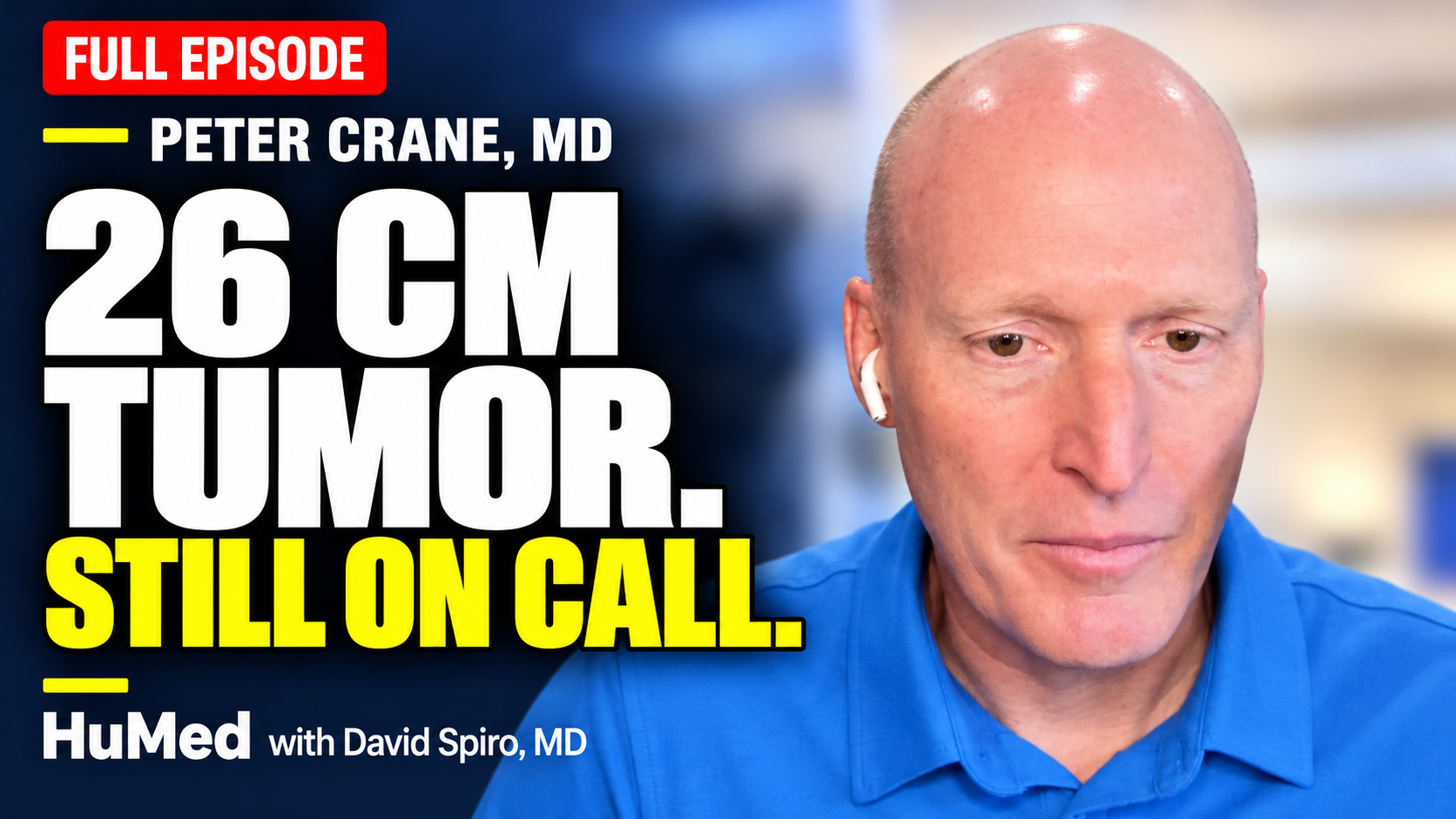
Peter Crane is a board-certified family physician who practices full time in rural Idaho and hosts the podcast Doctors Making a Difference. We were connected through a mutual friend, Dr. Rob Beck. About four years ago, jet-lagged after a trip to Italy, Peter woke up early with his hand on his abdomen and felt a mass. It turned out to be a 26-centimeter tumor. This conversation is about a doctor who became a patient in his own hospital, and came out of it certain he would choose medicine all over again.
A few moments from behind the scenes:
He took over for the doctor who delivered him. Peter came home to the small Idaho town where he grew up and took the place of the doctor who had delivered him, who was getting ready to retire. Fifteen years later he is still there, covering the ER, deliveries, inpatients, the ICU and the nursing home. “From the cradle to the grave,” as he put it.
Aisle thirteen. I told him about my five years as a pediatrician in Newport, Oregon, a coast town of about three thousand people, and the Saturday a woman with an infant in her shopping cart asked me to take a quick peek at a rash on aisle thirteen of the Fred Meyer. Peter’s reply: “There’s no anonymity in a small town.” His rule is to never say anything mean about anybody “because it’s probably somebody’s relative.” And his honest admission: “I do dread going to the grocery store, that’s for sure.”
We both hit the wall in rural practice. After five years of call every other night, I took a year off to travel around the world with my wife and our nine-month-old. Peter hit his own wall a few years before the tumor and fixed it with fewer 24-hour shifts and more partners. His summary: “Most people are not burned out if they get enough sleep.”
His surgeon made him promise. The surgeon who removed his tumor had been his surgery clerkship preceptor in medical school. She would not operate unless he promised her six weeks off. In Peter’s words: “Doctors are terrible at taking time off.”
The story at the heart of the episode
Peter felt fine. He thought maybe it was his spleen, maybe gas. He walked over to his practice partner, Dr. Lance Hansen, who had worked beside him for ten years and cared for Peter’s family as Peter cared for his. Lance palpated his abdomen: “Well, it feels like a mass.”
Two days later the CT was scheduled for late afternoon, on a day Peter was covering the ER. He got the scan, then settled in as the solo physician in the ER until 7 a.m. Sometime that night he pulled up another patient’s X-ray, and there was his own report.
“I couldn’t help myself. I clicked on it and there it said 26 centimeter, likely sarcoma.”
He called it a “baseball bat to the head sort of moment.” He had patients waiting, so he went back to work: “I’ll just go out and take care of my patients and do the doctor thing, ’cause that’s what I’m trained to do.” On a break, he called his wife to tell her what the scan showed.
I asked whether that was healthy. Peter’s answer: “Compartmentalization is born of necessity.” At some point, though, we have to deal with it. And about his own night, he was candid: “I don’t know that it was healthy for me to compartmentalize my own health care. I just didn’t know what else to do.”
He was 43, with his youngest child in fourth grade. Along with the shock came something he didn’t expect. “I was almost like ashamed of it… I’m the doctor? How could I get sick?” He didn’t want to tell anybody.
The biopsy pointed to a solitary fibrous tumor. Six weeks of radiation and a major surgery followed, and afterward nerve damage kept his left leg from bearing weight for weeks.
His practice was down to three doctors, and it’s hard to recruit a locum to a small town in January. Two friends from residency heard what was happening. Both said, “If you need me, I will come.” And they did. The hospital rented them a little house, and for six or eight weeks they ran his practice: his patients, his ER, his deliveries. “I didn’t worry about my patients for one second.”
Why this is the human side of medicine
Peter still lives on both sides of the curtain. Every two weeks he gets an IV infusion. The same nurses who care for his patients on the hospital floor place his IV, and he gets his CT scans from the same people he sends his patients to. Then he goes back to the floor and back to clinic.
Now, even in moments of chaos, he holds himself to one standard: “I would want to be the kind of doctor now that I would want for me or for my family members.” And he had a message for those of us who spend so much time on what’s broken in medicine: “We’ve got to stop talking so much about burnout and how everything is terrible in medicine. Because when you need a doctor, you need a doctor.”
When I asked Peter what really matters, his first word was “Family.” Then: “It’s the people, it’s the relationship.”
One line to take with you
In the middle of rehab, Peter had one clear thought, and it’s the one I’m carrying from this conversation: “If I got to do it again, I’d be a doctor.” He wanted to be part of “this team of healers that dedicate their lives to helping other people and showing up in that moment.” That thought led him to start his podcast, and today he is back in practice full time.
Watch the full conversation on YouTube, or listen on Apple Podcasts.