
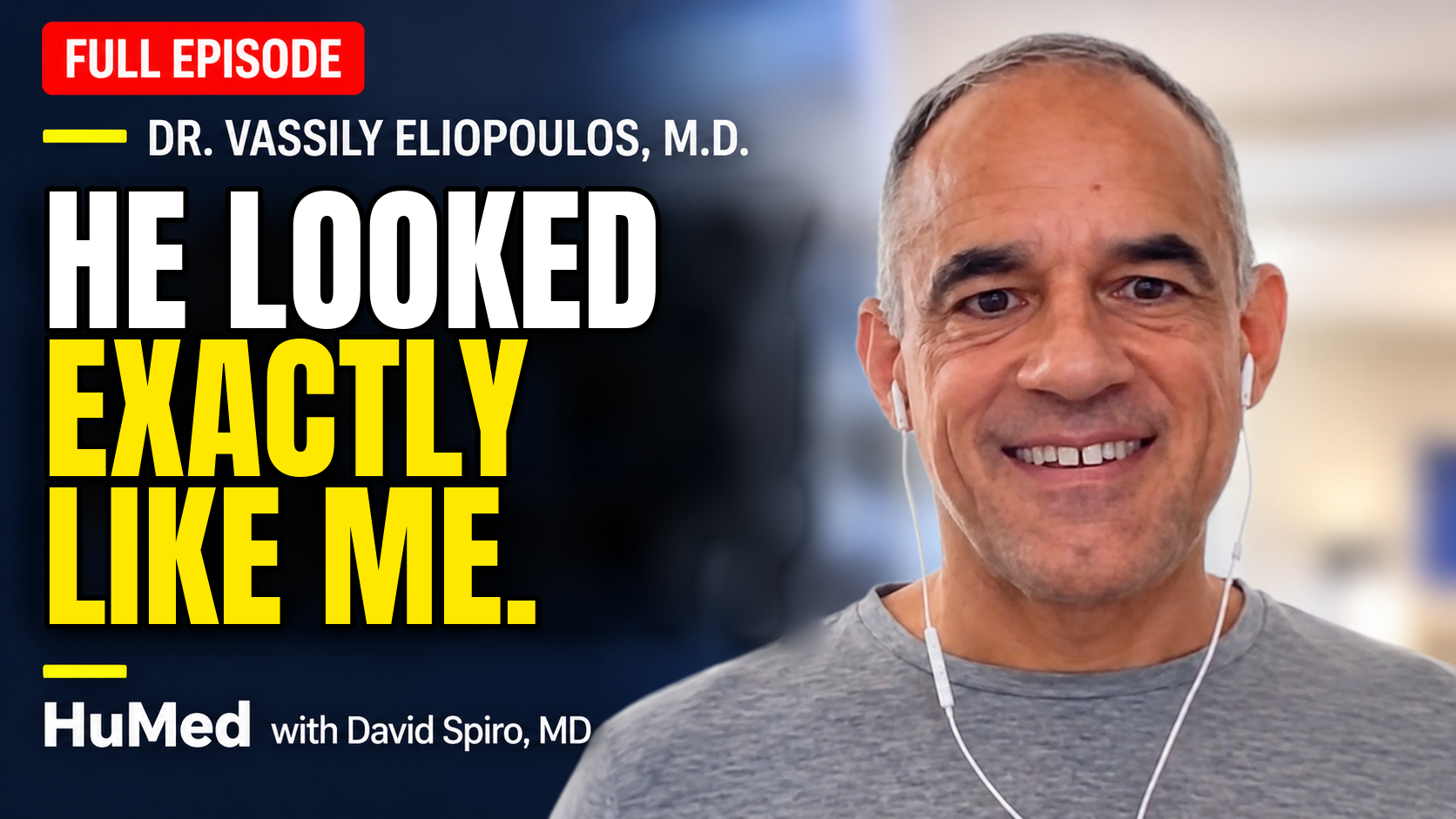
Vassily Eliopoulos, known to many as Dr. Vass, is a Cornell-educated physician who spent years as an ER doctor before co-founding Longevity Health in Denver, where he is chief medical officer. He focuses on longevity medicine and cardiovascular prevention, and off the clock he holds a black belt in Brazilian Jiu-Jitsu. Long before he built a practice around prevention, he saw his own future in a patient he was coding.
A few moments from behind the scenes:
I interrupted his two-fer. He opened by promising two quick stories. Right after the first one, I jumped in with a question, after explaining that I love two-fers and even three-fers, but not four-fers, which in the ED means four kids in one room. We never got back to story number two. He owes us a return visit.
He couldn’t turn off the care switch. Some of the best ER doctors, he said, can walk in, lay out the options, make a recommendation and sign out at the end of the shift. He always gave a little more. By the end of his ER career he felt “like a sponge that was wrung out so dry, like it was dry and cracked.” A family, a mortgage and the golden handcuffs made leaving feel impossible.
Getting his sleep back took years. First he normalized his schedule: weekdays, weekends and nights off. Then came personal healing, including therapy he still does every other week. The last step was a CBT-I specialist (cognitive behavioral therapy for insomnia), which, he pointed out, isn’t talk therapy at all. It’s about planning your day so your body is ready to sleep at sleep time.
A quarterly board meeting with his kids. He borrowed this one from a client. Once a quarter he clears a whole day, calls it a board meeting, and his kids choose what they do. He called it transformational. He also protects at least one dinner a month with his wife.
My own realization in Hungary. Every late summer I spend about two weeks in Eastern Europe with my best friend and a group of his friends: thermal springs, a modified fast, lots of sauna. I went for the fasting. What I realized on this last trip is that the most valuable part is the time with the guys. Vass took it a step further. He sees that kind of community as a spiritual practice.
The story at the heart of the episode
In his thirties, Vass was working in a rural ER in Rock Springs, Wyoming. He had put family and career ahead of his health for years, he didn’t like what he saw in the mirror, and with familial hypercholesterolemia, his cholesterol was never really under control.
Then he coded a man who had a heart attack and a rhythm that was very hard to control. They got him back and flew him to Utah, and Vass never learned how he did. But this code was different. The man was Vass’s age and a little overweight. No drugs, nothing else driving it. He just had cardiovascular disease. And he looked exactly like him.
For years Vass had looked at ER patients and thought, that’s me in fifteen years, that’s me in seven. That night the number got too close for comfort.
“I sort of felt in my soul, I was like, this is me. I’m on the road to this outcome and I don’t want this.”
Why this is the human side of medicine
Dr. Vass didn’t walk away from that code thinking about a case. He saw himself in the patient, and it changed the direction of his life.
He believes medicine has drifted toward the data and away from the relationship. The data still matters to him, a lot. But the AI tools already “don’t forget the 50th differential diagnosis on the list,” he said. “I can’t even remember the fifth.” His worry: “We’re training technicians. We’re not training physicians.”
I asked him about Dr. James Wittig, a guest on the show who worked for decades on five hours of sleep a night and nearly died of a blocked coronary artery, while no one around him said a word. Vass’s answer was blunt: “We don’t know how to tell people to be healthy.”
What he learned instead came from patients near the end of life. If you hold space for just a few minutes, he said, people tell you the truth. What he heard from them pointed to one thing: “your relationship with yourself is the most important relationship that you’re ever gonna have.” That’s why community, connection, purpose and spirituality sit at the base of his longevity pyramid, beneath sleep and beneath nutrition and exercise.
One line to take with you
I asked what today’s Dr. Vass would tell the exhausted ER doctor he was 20 years ago. His answer: “Trust your intuition and don’t let fear be the reason that you stay stuck.” He was honest that the younger him might not have been able to hear it. “You’re only ready when you’re ready.” For anyone in medicine who feels stuck right now, that’s a pretty good place to start.
Watch the full conversation on YouTube, or listen on Apple Podcasts.