
Behind the Mic with Dr. Aditya Pawar: “It Started From a Mistake”
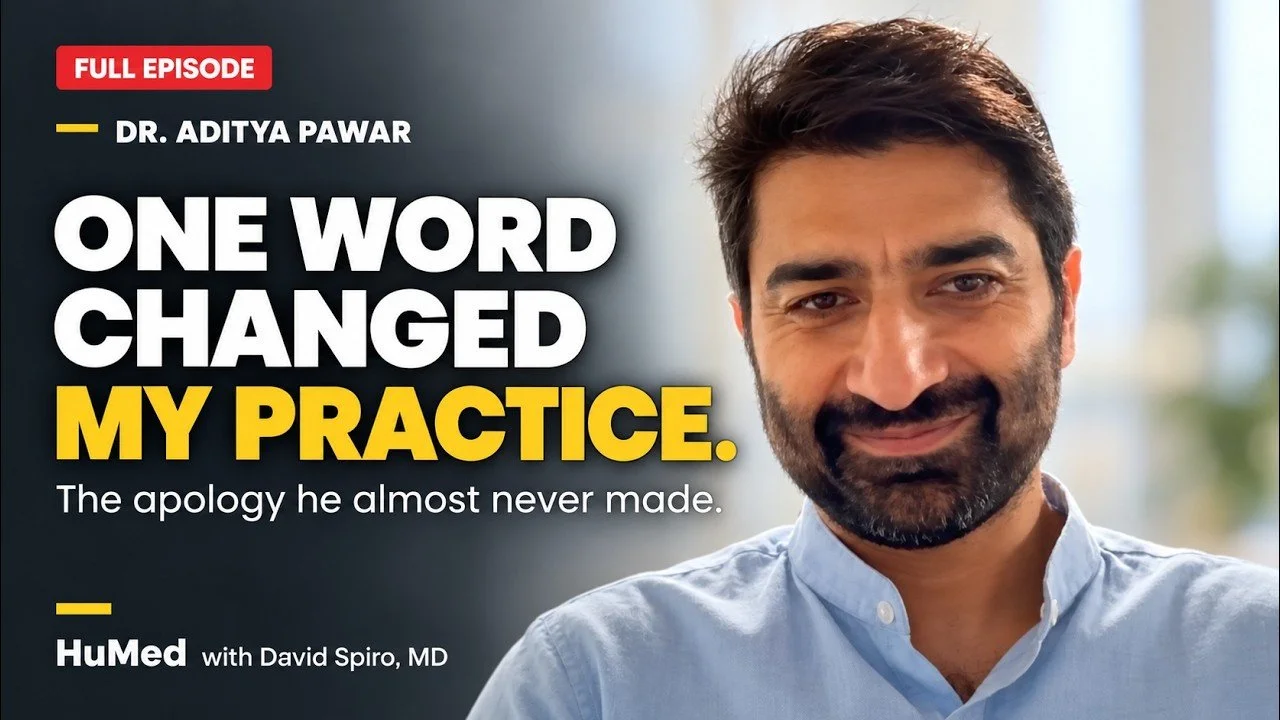
Aditya Pawar is a transplant nephrologist in the Harvard Medical School system and a prolific essayist, with recent pieces in JAMA and the New England Journal of Medicine. The way he writes about connecting with patients moved me, and I wanted him to tell the story behind his NEJM essay, “Safe Space,” on the show.
A few moments from behind the scenes:
I asked permission to invade his safe space. About halfway through, I wanted to ask something personal about what he left behind in India, and I told him I hoped I wasn’t invading his safe space too much. He answered before I finished the sentence: “Please do.”
We compared notes on family. I told him that, as someone who is fifth or sixth generation Jewish, I see more similarities than differences between Jewish culture and Indian culture. He grew up in a small town in India, where being safe as a child meant running back to his grandparents.
I left with an invitation. I told him I look forward to spending time with him in Boston when I visit my son. His answer: “Thrilled to have you.”
The story at the heart of the episode
It was residency, a 24-hour night call, and he was admitting a lot of patients. He was caring for a couple, the patient in their nineties, and in the history he wrote the word “senile.” He had heard the word and assumed it was simply what you call someone who is old. It isn’t. His mentors corrected him, and he fixed the note.
That could have been the end of it. He had moved on to a different rotation. But the edit was still visible, and at some point the patient was able to see it. He kept asking himself what he would do if this were his own family. So he reached out.
He told me that every single cell of his body was telling him, “Don’t do it.” He was an insecure resident who was already making mistakes, and here he was reopening one that had been closed. What settled it was simple: even if they got mad, he would have done his part, and he would sleep well.
They were not mad. He called them the nicest couple, and they were grateful that he had opened his safe space to them. He didn’t understand what that meant at the time. Years later, it became the essay.
Why this is the human side of medicine
This is what HuMed is about. Aditya’s question now is, “Who is this safe for?” He used to think of a safe space as a place where he could be vulnerable and afraid without being judged. Then he realized that was mostly about protecting himself. He wants the space big enough to include the patient, and he writes about moving from safe spaces to brave spaces: sitting with a patient and saying what he knows, what he doesn’t know, and that they will work through it together. He also pointed out that patients are already being brave. They are sick, and they show up.
He teaches a communication course to first-year medical students, and he tells them there will be 20-minute visits that need far more than 20 minutes. You will have to apologize to every patient after that one, and to the administrators. It’s worth it. I told him about my shift the day before, when I stayed with my team for a 30-minute debrief after a very hard case, knowing patients were waiting.
We closed with his uncle, Dr. S.S. Jamwal, the one doctor in his family, who practices in Jammu in northern India. As a medical student, Aditya went with him on Sunday evenings to care for people in a village, and he would get upset about the patients they couldn’t help. His uncle told him that as physicians, we have always lost. No patient lives forever. That taught Aditya where his limits are, and that when he reaches them, he can still give his best to the family. After one of the first codes he ran as a resident, six family members came up one after another to hug him while he was signing out to his attending. “You give a lot,” he said, “but you receive a lot too.”
One line to take with you
Aditya’s advice to his students: “When you are in that room, you be in that room.”
Watch the full conversation on YouTube, or listen on Apple Podcasts or Spotify.
David